 ACLSMED™ PACER · Temporary pacing sim
Turn the dial.
Watch for capture.
Practice temporary pacing on a live pulse generator and a bedside monitor. Turn RATE, OUTPUT and SENSITIVITY and the ECG, the markers and capture respond beat by beat.

 Coming soon to the App Store and Google Play
Google Play coming soon
Free to start · Pro $39.99 a year or $79.99 once
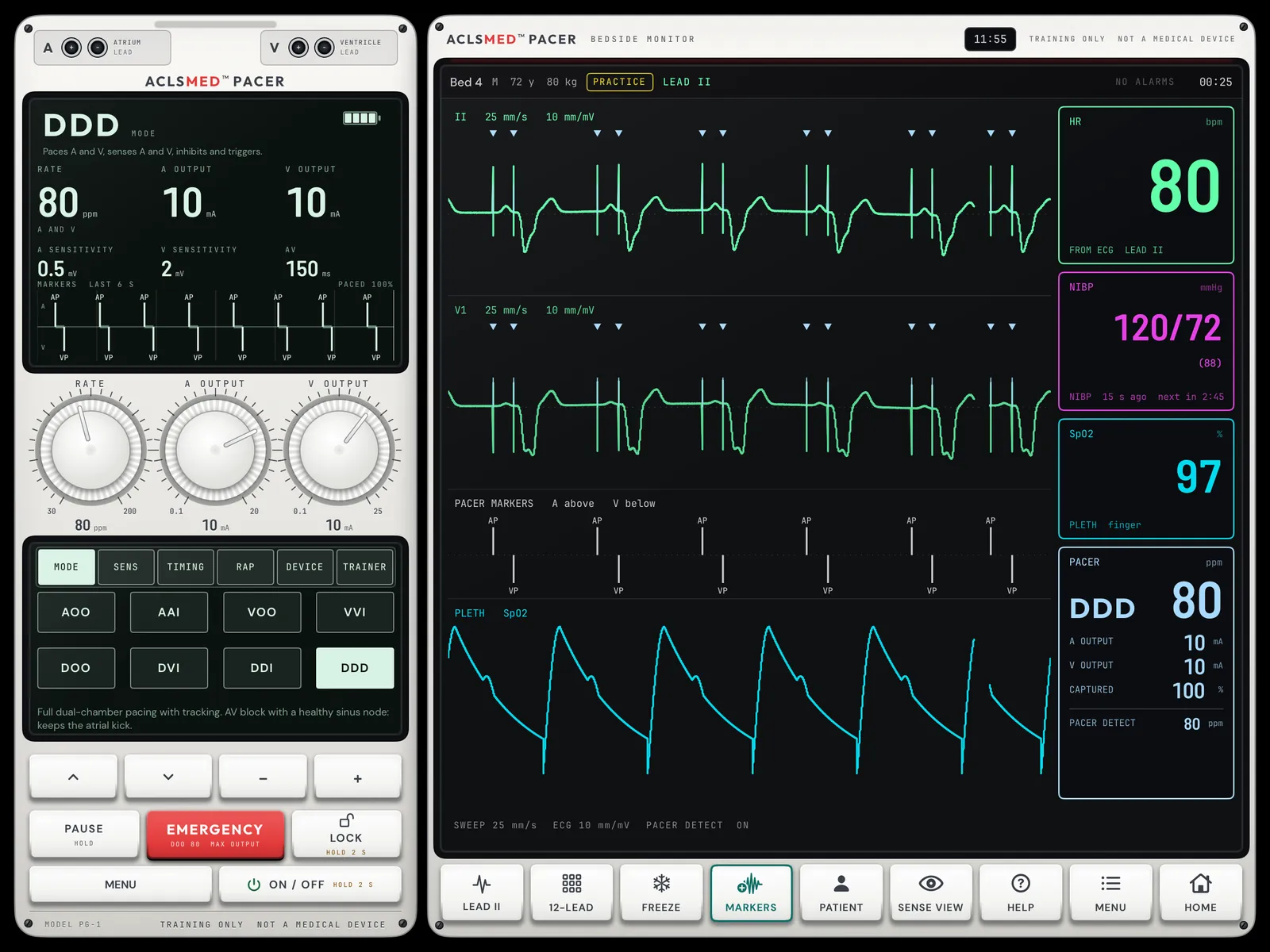
Three dials, two screens,
eight modes.
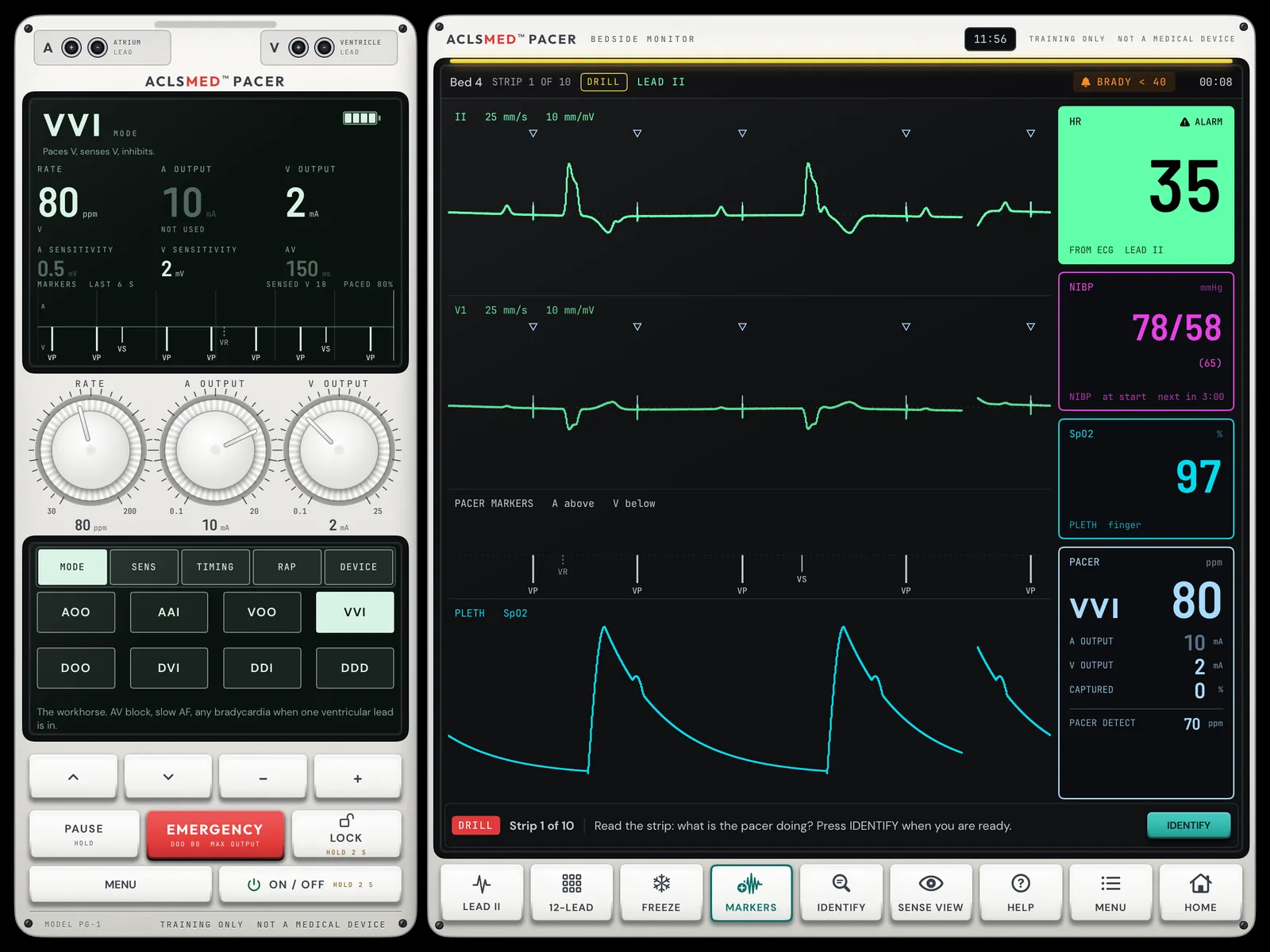
A generic teaching generator with the keys you expect: RATE, A and V OUTPUT, A and V SENSITIVITY, MODE, PAUSE, EMERGENCY and LOCK. A heart model and a generator model run underneath, so every turn has a consequence.
- AOO to DDD, rapid atrial pacing, AV interval, upper rate and PVARP
- A marker strip of what was paced and sensed
- Alarms for low battery, lead off, noise, paused and locked
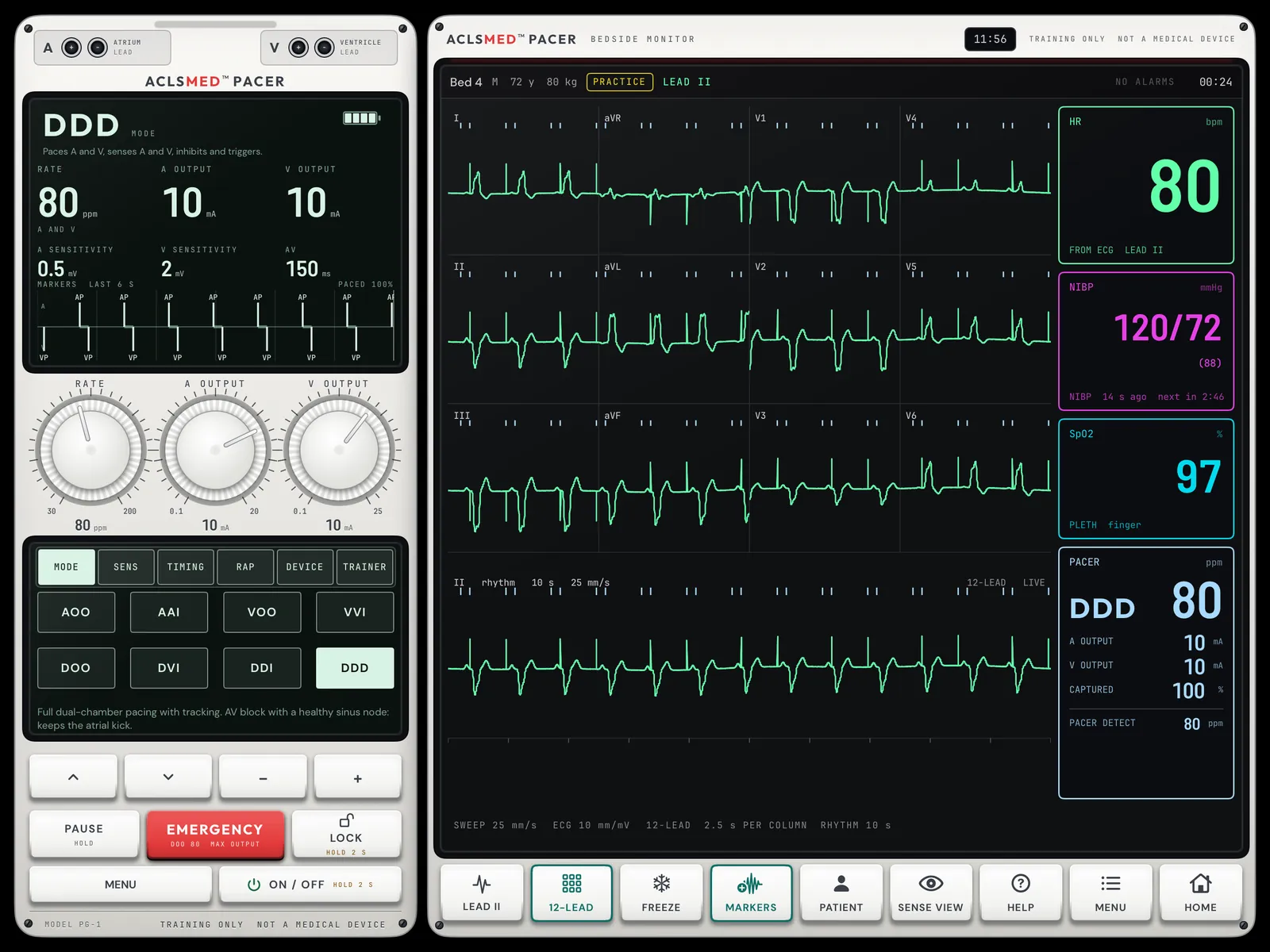
See what the generator sees.
ECG with a choice of lead and a 12-lead view, markers, FREEZE and SENSE VIEW, plus vitals and a PACER tile that reports capture. In Practice mode the PATIENT page changes the rhythm, rate, thresholds and escape, or adds a fault with one tap.
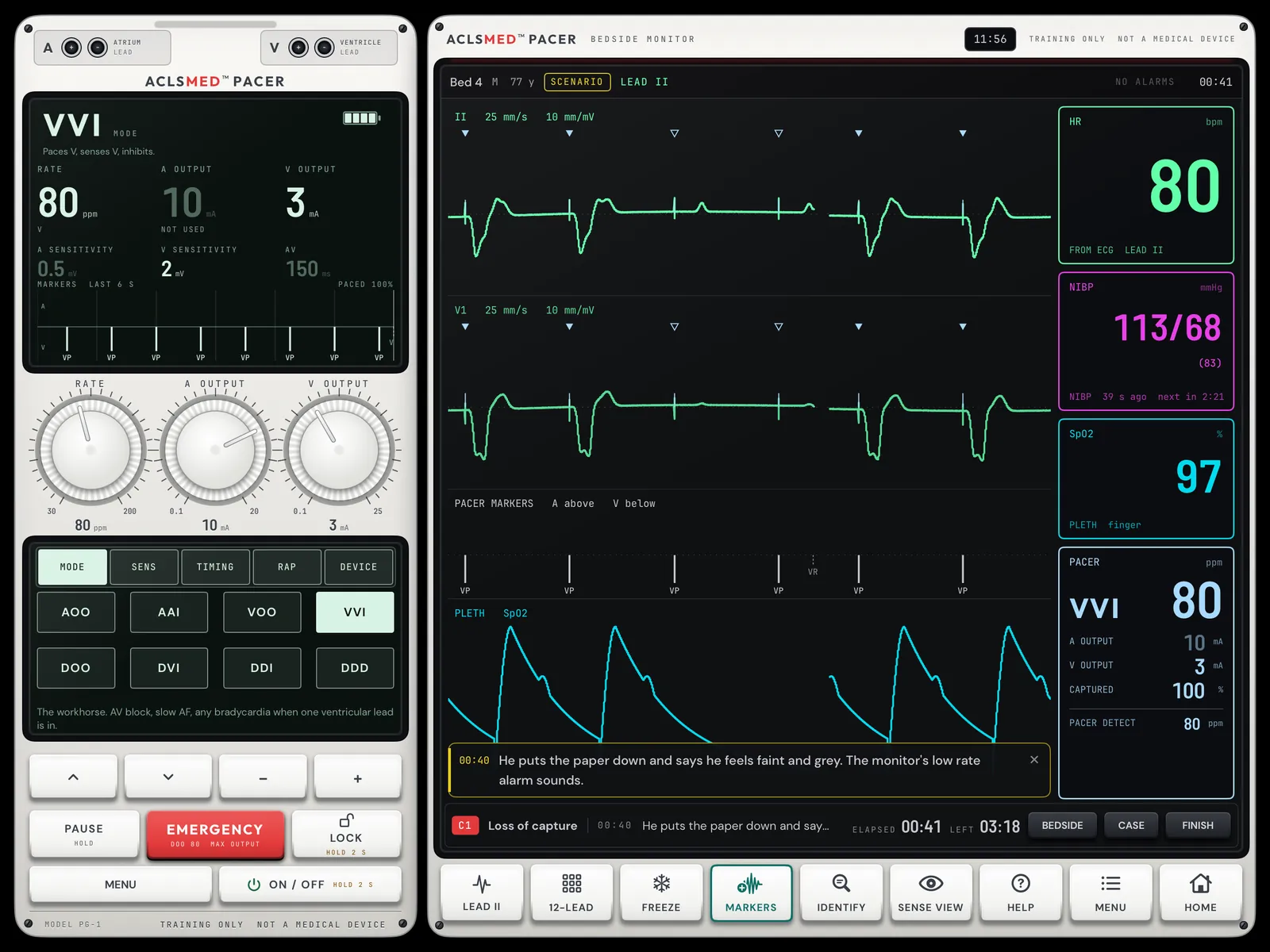
8 lessons
on the real dials.
Stepped lessons with SHOW ME on the control you need: what the generator does, rate and capture, sensitivity and sensing, the modes, dual-chamber timing, atrial pacing and overdrive, troubleshooting, and the paced 12-lead. Each ends with check questions.
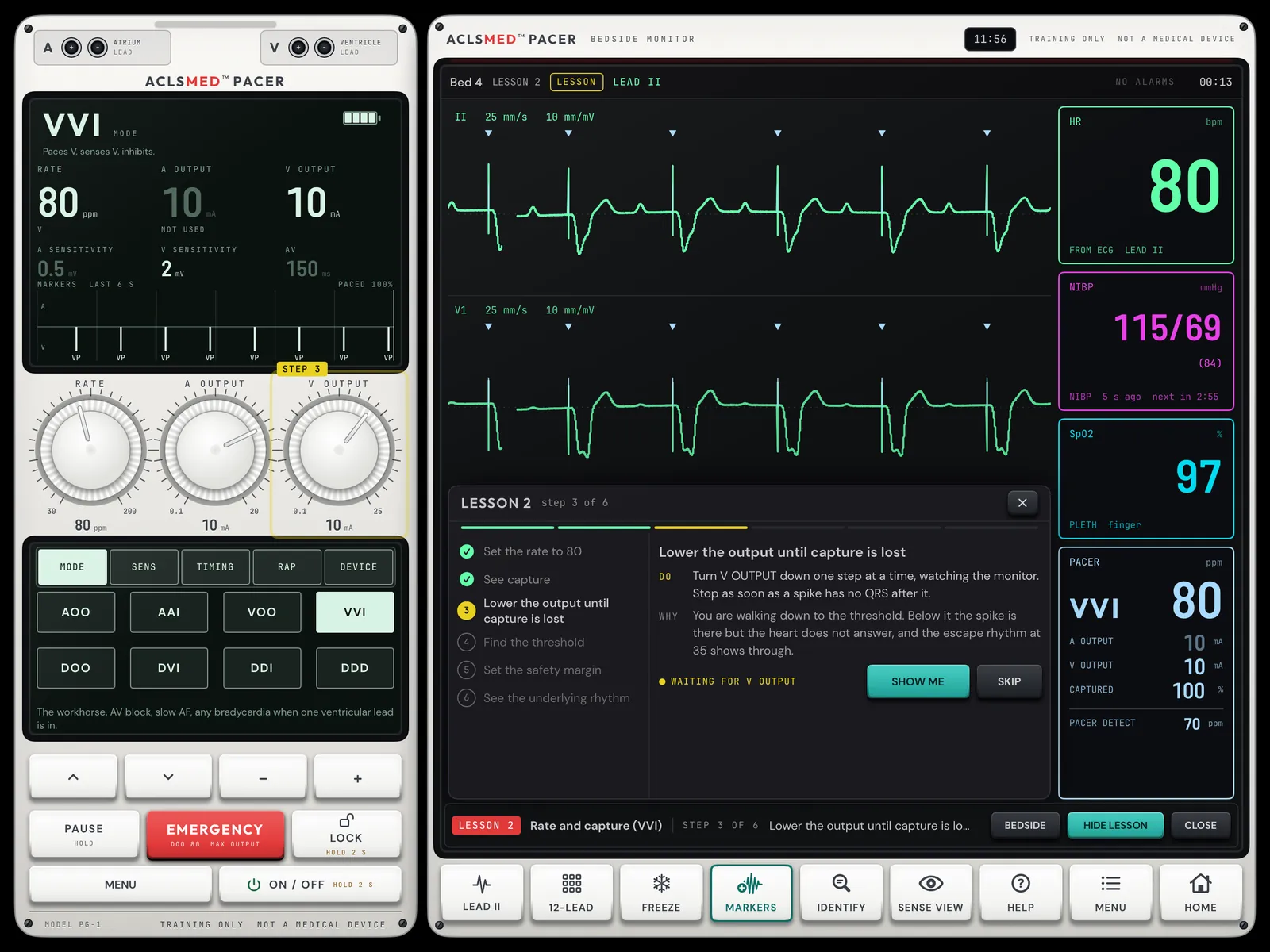
Name the problem.
Then fix it.
Ten strips a round. Read the strip, name the problem, then correct it on the generator. Points for naming, fixing and speed.
Every step,
and when you did it.
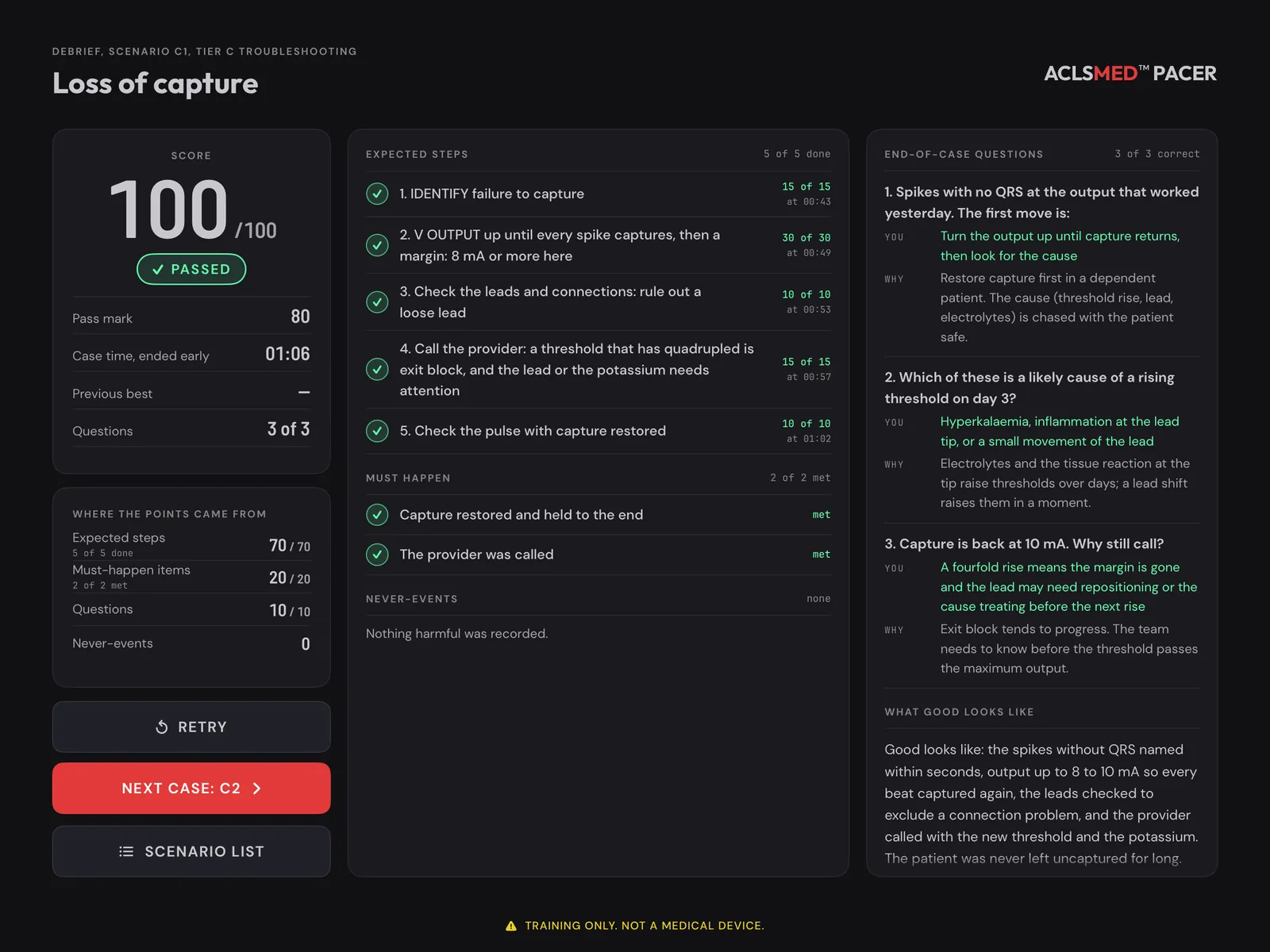
Every case ends with your score, the critical actions met or missed, each expected step and when you did it, any harmful action, questions with the reasoning, and a timeline. Best scores are saved.
Two devices, one class.
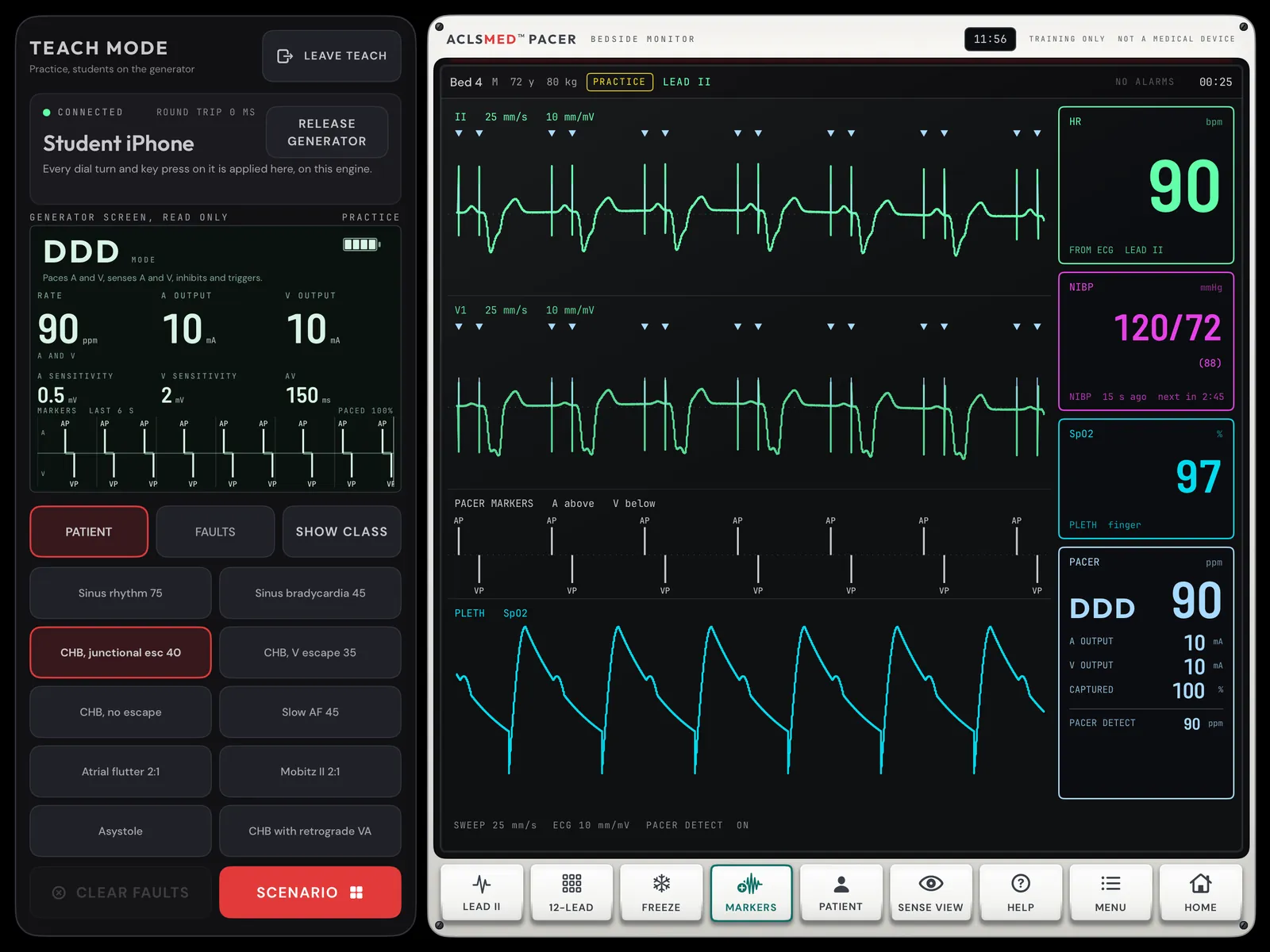
One tablet is the monitor the class watches. A phone or a second tablet is the generator the students hold, and every dial turn is scored as it would be for one learner.
Start the monitor
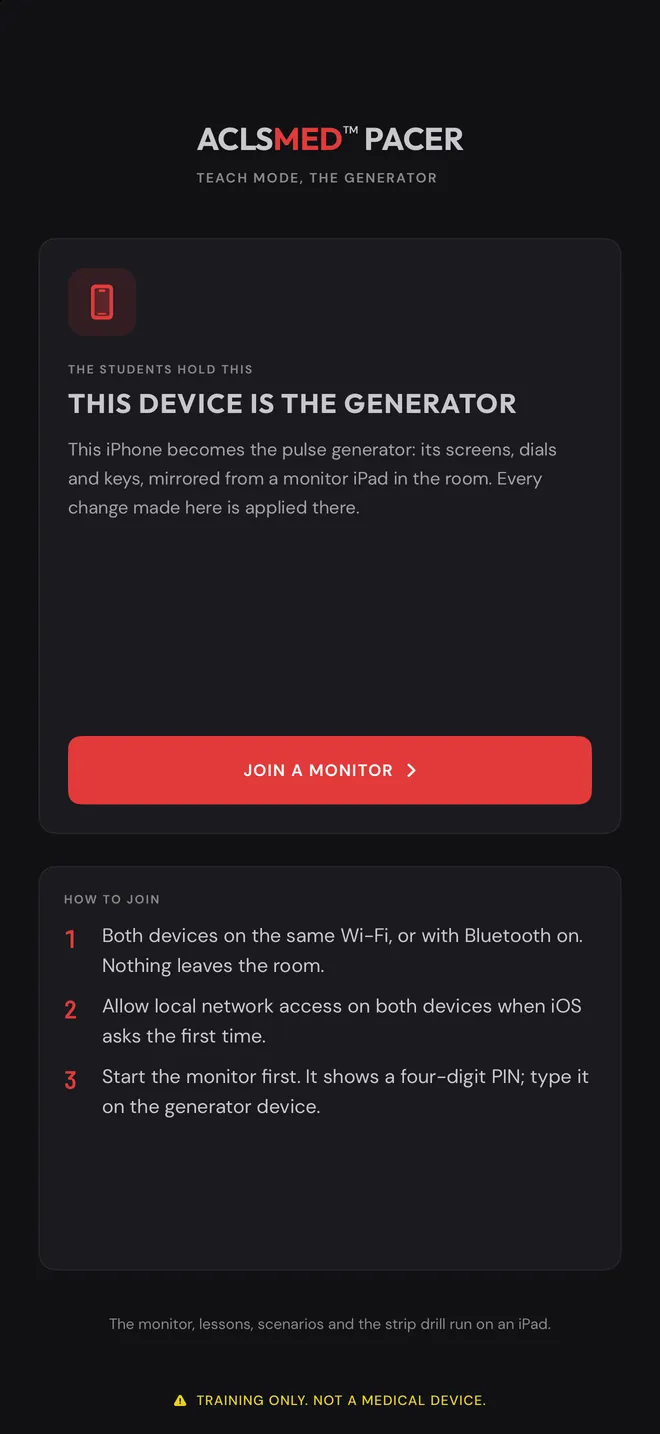
Open TEACH on the tablet at the front of the room. It shows a four-digit PIN.
Join from the generator
On the phone or second tablet, pick the monitor and type the PIN. The two devices link directly over Wi-Fi or Bluetooth.
Pass it around
Students turn the dials in their hands while the class watches the ECG respond. Nothing leaves the room.
TEACH links like with like: iPad and iPhone pair with each other over Wi-Fi or Bluetooth, and Android devices pair with each other over the same Wi-Fi. An iOS device cannot pair with an Android device. On a phone, ACLSMED PACER is the generator.
Running a class? The ACLSMED™ PACER instructor manual covers every dial and key, the 20 cases, scoring and TEACH mode step by step.
The generator,
phone sized.
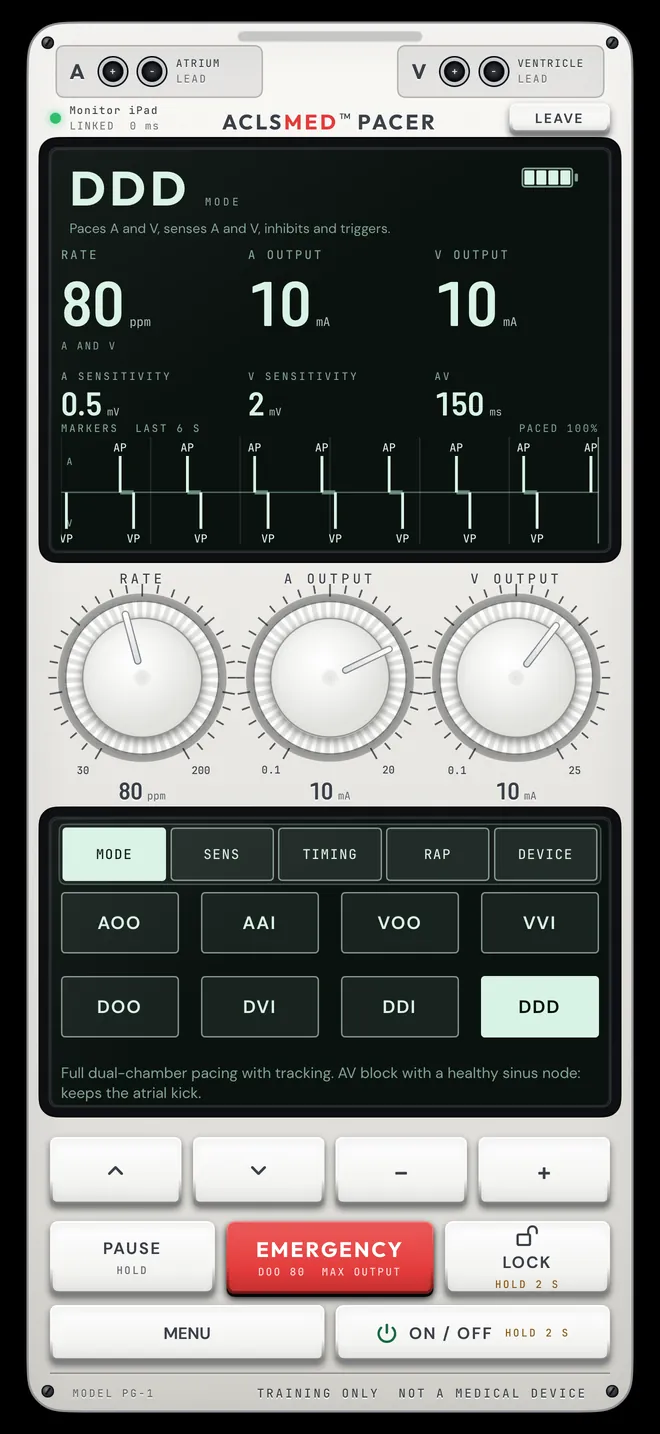
On iPhone and Android phones the app is the TEACH generator: the same dials, keys and screens, sized for one hand, linked to the monitor tablet.
Three short clips, no sound needed.
Recorded from the app on a tablet. Each clip is under 30 seconds.
Practice mode
Turn the output down until capture is lost, then bring it back.
A scored scenario
The patient changes. Identify the problem and correct it on the generator.
TEACH mode
The monitor at the front, the generator in a student's hands.
20 cases in four tiers.
Set-up
Start pacing, ventricular threshold, sensing threshold, dual-chamber set-up, atrial threshold.
Modes and timing
Choose the mode, flutter during DDD, pacemaker-mediated tachycardia, upper-rate behaviour, overdrive a flutter.
Troubleshooting
Loss of capture, undersensing, oversensing, failure to output, low battery, lead dislodgement.
Clinical management
Inferior infarct with heart block, block after a valve procedure, slow atrial fibrillation after bypass, asystole with a wire in.
Free to start. Pro when you are ready.
- iPad
- Android tablet
- iPhone: TEACH generator
- Android phone: TEACH generator
Coming soon to the App Store and Google Play
Google Play coming soon
Prices in US dollars. There is no trial period; the free tier does not expire. ACLSMED PACER Pro is its own purchase inside the app. It is not part of ACLSMED Sim Pro or the Suite.
No account, no sign-in, nothing collected. Works offline. TEACH mode talks only to the device beside it.
Training only. Not a medical device.
ACLSMED PACER is education software for a simulated patient. It does not connect to any pacemaker, generator or patient and must not be used for any decision about a real patient. The generator is a generic teaching generator; real generators differ, and your unit policy and the operator's manual for your generator always come first.
For instructors: the ACLSMED™ PACER instructor manual.
Also from ACLSMED: ACLSMED™ IABP, ACLSMED™ CPR and ACLSMED™ SIM.